
(APEH/APWH/APUSH)
Short Answer questions seem like they would be pretty easy however they are can be deceptively tricky if you are not careful. First off, none of your responses can be any of the following:
- Sentence fragments
- “Bullet points”
Next, when doing a short answer question on the AP exam or any timed exam for that matter, never start by reading the prompt! This may sound odd, but I always suggest to read the the questions first. Simply put, you’ll be pressed for time and you need to know EXACTLY what you need to be searching for. Take a look at this example below.

Notice, that there are 3 separate parts that need to be answered. Each one is worth 1 point on the AP exam. Also notice that the questions is asking for different TYPES of changes ie. political, economic changes. These are highlighted in Yellow.
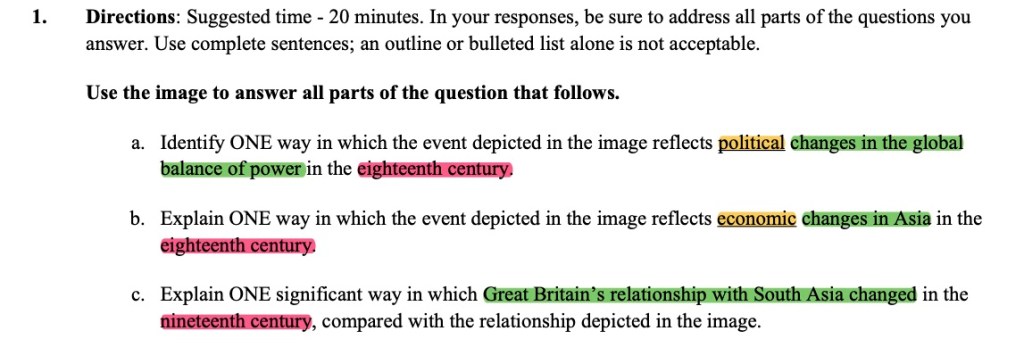
Each one is specifically asking for a different impact. You MUST answer what the question is specifically asking for. These are highlighted in Green. Question ‘a‘ is asking for “Changes in the global balance of power“. The next question marked ‘b’ is asking for “Changes in Asia”, followed by question ‘c’ asking for “Great Britain’s relationship with South Asia”. You must take note of these differences. I ALWAYS suggest highlighting/underlining/annotation when reading the question.
Lastly, you need to make sure that you keep your answers constrained to the appropriate time period ie. 18th vs 19th century. I know this is not a popular opinion, but I always have my students learn dates for this reason. If the examples you cite are not within the proper time period you WILL NOT receive credit. I highlighted the time frames in pink.
Next, let’s take a look at HOW you can answer SAQ questions with the “TEA” Method.
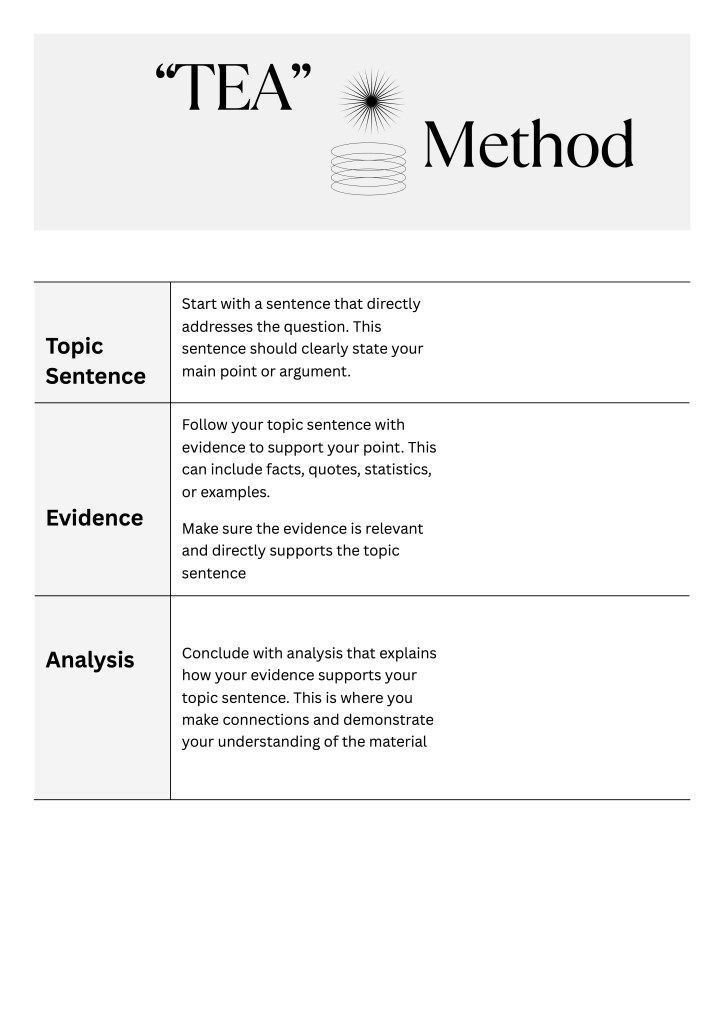
Using the TEA method, the following could be used to answer the first question:
Identify ONE way in which the event depicted in the image reflects POLITICAL changes in the global balance of power in the eighteenth century
In the 18th century, the British East India Company greatly expanded their influence in India and shifted the global balance of power from Asia to western Europe. The power of the once great Mughal empire was greatly diminished at the hands of the British East India Company in 1757, with their defeat at the Battle of Plassey . Once political and military dominance was firmly in the hands of the British, they would continually expand their power throughout the 18th and 19th century at the expense of traditional Asian kingdoms.
If you notice the TOPIC SENTENCE takes key parts from the question and incorporates them directly into the answer.
In the 18th century, the British East India Company greatly expanded their influence in India and shifted the global balance of power from Asia to western Europe.
Next, the 2nd sentence further expands on the direction of the shift in global power and also provides an historical example to support it.
The power of the once great Mughal empire was greatly diminished at the hands of the British East India Company in 1757, with their defeat at the Battle of Plassey.
Finally, the 3rd sentence provides further analysis on the previous explanation to fully answer the question.
Once political and military dominance was firmly in the hands of the British, they would continually expand their power throughout the 18th and 19th century at the expense of traditional Asian kingdoms.
 Study with Sep Home page