
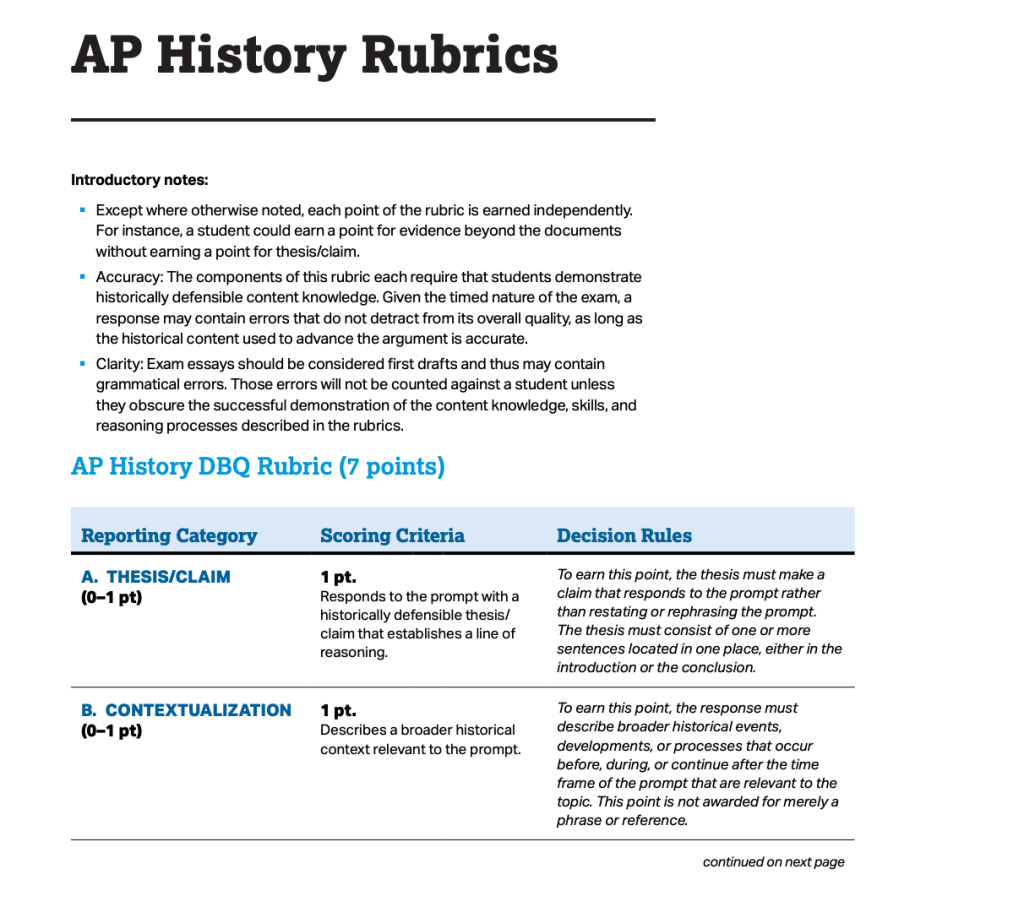
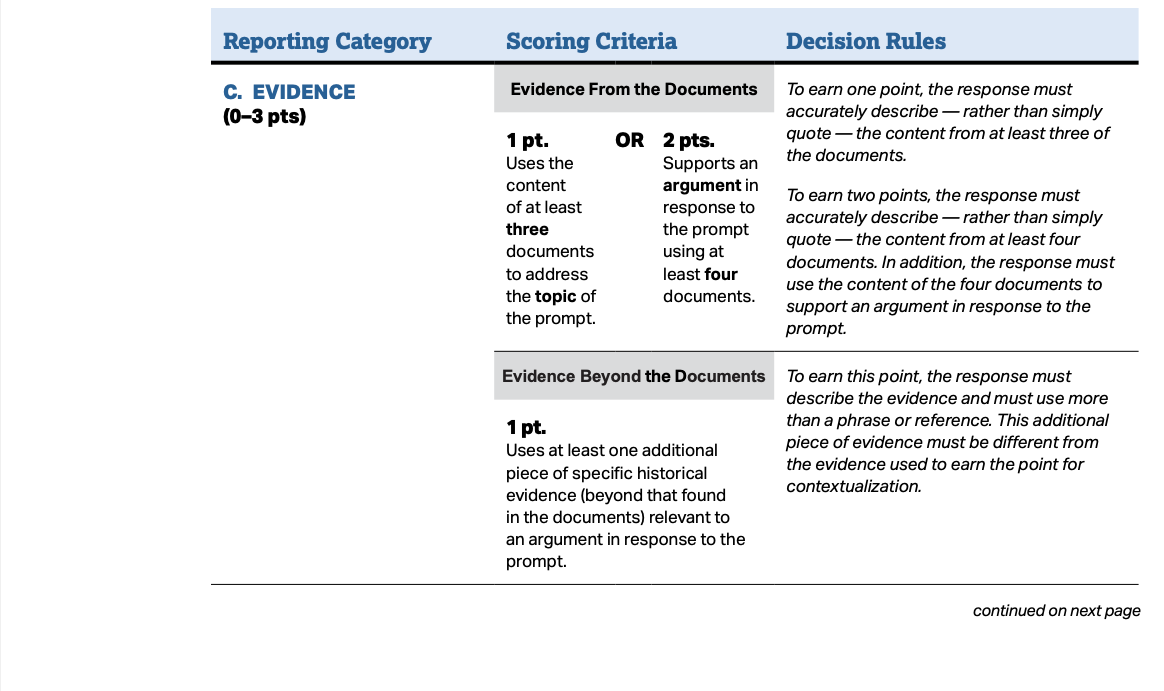
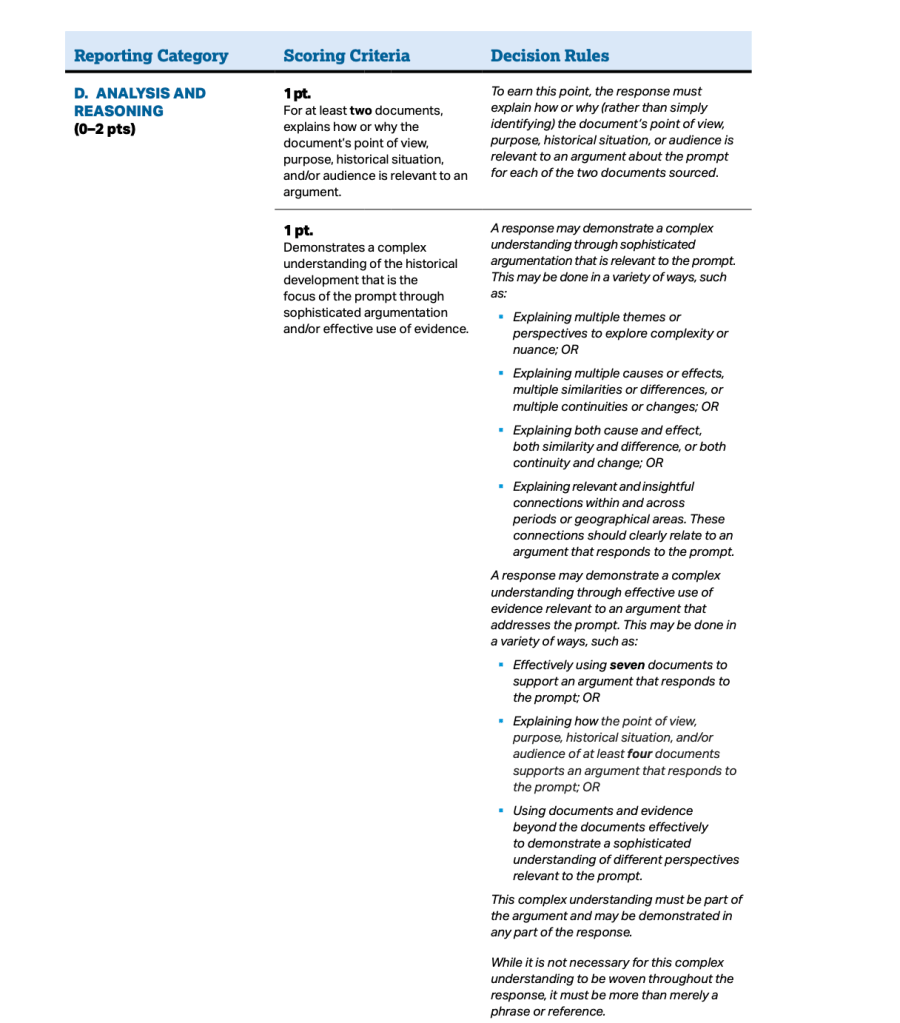
During the AP exam you will be required to write a DBQ or Document Based Question. There will be a question based on one of the topics or concepts covered in the course and you will have to analyze 7 Documents and write a thesis driven essay with 2-3 supporting arguments. Each of your arguments must also be supported with evidence found within the documents. Students should aim to use 4 out of 7 documents but it’s better if you can use all 7! Below is a step by step tutorial on how one should approach writing a DBQ. First, take a look at the AP exam’s rubric to get an idea of what graders are looking for.
AP Rubric for DBQ:
Step 1: Identify Question
(2-3 minutes)
- Read the prompt carefully: Identify the historical context and the specific question you need to address. Decode what it is asking for.
- Note keywords: Look for terms that indicate what kind of response is expected (e.g., compare/, analyze, evaluate to what degree etc.
- Identify Time Period and Region
- you must give frame your answer in the specific time period and region that the question is asking for
- If the question is asking for answers from the 16th and 17th century (AP European) or 1200 -1450 (Period 1 in AP World) you cannot give answers that are outside that reference point.
- Do a quick dump on the subject from your own knowledge
- Jot 3–4 bullets you already know from before/during/after the period (events, policies, tech, ideology). These will feed your Contextualization and Outside Evidence later.
Step 2: Read and Group Documents
(15 -20 minutes)
- Read all documents: Skim through the documents provided to understand their content and perspective.
- Analyze documents: Group them by theme, perspective, or argument. This will help you structure your essay later. For each document you should do the following
- Main idea in 5–7 words
- Which side of the argument it supports
- HAPPY angle you could use (author, audience, purpose, situation)
- *H*istorical Context
- *A*ntended Audience
- *P*uprose
- *P*oint of View
- *Y* why is it important?
- Type (text, image, data) for variety
- Bucket documents into 2–3 categories (causes, effects, economic/political/social; continuity/change; similarity/difference). Aim to place all docs.
Step 3: Thesis Construction
- After you have categorized your documents you should a solid idea of what you plan on arguing as well as your supporting points.
- Thesis should have a clear position that directly addresses the question with clear supporting arguments.
- Your thesis should allow you to easily outline your essay with your supporting points acting as a mini-outline of your essay.
Step 4:Quick Outline
(3-5 minutes)
- Intro: Context (3–4 sentences) → Thesis (1 sentence).
- Body 1/2/3: One category each. For each body:
- Claim sentence for the category
- 2–3 docs (quoted/paraphrased once each) supporting the claim
- HAPPY analysis for at least one doc in that paragraph
- Tie back to argument
- Outside evidence: place where it fits best.
- Complexity: plan a moment to qualify/compare/trace change over time.
- Conclusion: Restate argument & big-picture significance.
THIS IS VERY HELPFUL TO AVOID ORGANIZATION MISTAKES AND ELIMINATING THE NEED FOR ARROWS OR ASTERISKS FOR STUFF YOU MISSED
Step 5: Write your Essay
- Intro: Context (3–4 sentences) → Thesis (1 sentence).
- Body 1/2/3: One category each. For each body:
- Claim sentence for the category
- 2–3 docs (quoted/paraphrased once each) supporting the claim
- HAPPY analysis for at least one doc in that paragraph
- Tie back to argument
- Outside evidence: place where it fits best.
- Complexity: plan a moment to qualify/compare/trace change over time.
- Conclusion: Restate argument & big-picture significance.
Step by Step Tutorial
A) Introduction (Context → Thesis)
- Contextualization (1 point): Set the stage with relevant developments immediately connected to the topic (no long backstory).
- “Following the shocks of the 1848 revolutions and amid accelerating industrialization…”
- Thesis: one clear sentence answering the prompt and naming your categories.
B) Body Paragraph Template (use 2–3)
Topic sentence (your claim for the category).
Evidence from docs (2–3 documents):
- Summarize or cite specifically (no long quotes).
- Explain how each doc supports the claim (cause, effect, example).
HAPPY for at least one doc (earn Sourcing): - Historical situation: “Written amid ___, which pressures the author to ___, making the argument emphasize ___.”
- Intended audience: “Aimed at ___, so it stresses ___ to persuade ___.”
- Purpose: “To justify/protest/recruit, shaping the tone and the selected facts ___.”
- Point of view: “As a ___, the author benefits/suffers from ___, biasing the stance toward ___.”
Mini-conclusion tying the evidence back to your claim.
🔑 Sourcing must affect interpretation or reliability, not just label facts about the author.
C) Outside Evidence (1–3 sentences)
- Provide one concrete, specific example not in any doc that advances your argument.
- Name it and explain its relevance.
- “The Zollverein, a Prussian-led customs union, exemplifies economic integration that strengthened nationalist aims, reinforcing the trend shown in Doc 4.”
D) Complexity (weave it in)
Ways to earn it (pick one and do it well):
- Qualification/nuance: acknowledge limits, exceptions, regional variation.
- Multiple causation: weigh primary vs. secondary causes.
- Change over time: show shifts within the period.
- Comparison: relate to another region/time to deepen explanation.
- Contradiction/tension: explain why evidence points in different directions and resolve it.
Sentence frames:
- “Although ___ suggests ___, the predominance of ___ indicates ___; however, in ___ the pattern diverged because ___.”
- “In the short term ___, but over time ___ as ___ altered the initial effect.”
E) Conclusion (3–4 sentences)
- Restate your thesis in fresh words.
- Echo your categories + the “so what” (historical significance, long-term impact).
- Optional quick comparison/continuity note to reinforce complexity.
 Study with Sep Home page